

Quick answer
The best chimney crown is a reinforced concrete slab, either poured in place or precast, that slopes away from the flue, overhangs the brick on every side and has a drip edge underneath. Both poured and precast crowns work when they are built to the same standard. A thin mortar “wash” is the weakest option because it cracks early and lets water into the brick below.
Most homeowners only notice the crown when something goes wrong: a crack at the top of the stack, a stain on the ceiling or brick that flakes away from the top down. Knowing what a crown is made of, and how a good one is built, makes it much easier to judge an inspection report or compare two quotes.
This guide covers the crown types you will see on masonry chimneys, how poured and precast crowns compare, the measurements a well-built crown should meet, and the mistakes that cause early failure. It also clears up the difference between a crown, a cap and a chase cover, which are often mixed up. Specs below come from published guidance by industry sources, linked at the end.
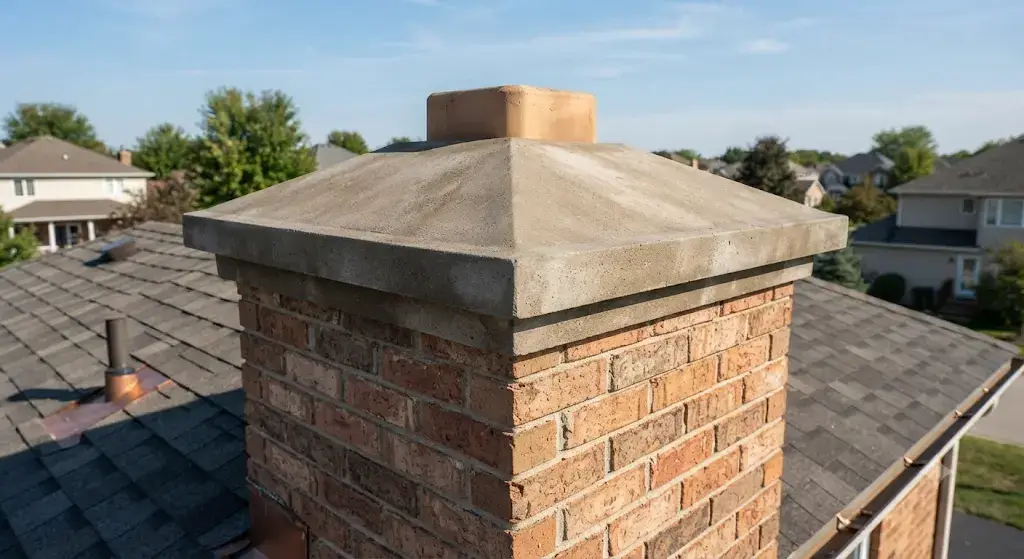
What is a chimney crown?
A chimney crown is the cement-based slab that seals the top of a masonry chimney. It sits on top of the brick or block, surrounds the flue liner and sheds rain away from the masonry below. According to the Jaspector chimney crown entry, it is often cementitious and should slope away from the centre.
The crown does one job: keep water out of the chimney structure. Brick and mortar joints absorb moisture, and in a climate with regular freeze-thaw cycles that moisture expands as it freezes and widens every small gap. A sound crown stops that cycle at the top, which is why a failing crown often shows up later as leaning brick, white salt staining or water leaking around the chimney.
A crown is not the same as a chimney cap. The crown is the masonry slab; the cap is the metal or masonry cover over the flue opening itself. The comparison table further down explains the difference.
Chimney crown types compared
Most crowns fall into one of five groups. Rumford’s chimney cap guidance notes that concrete, stone or other masonry crowns can be precast, poured in place or assembled in place.
| Type | What it is | Main strength | Main weakness | Verdict |
|---|---|---|---|---|
| Poured (cast-in-place) concrete | Concrete formed and poured directly on top of the chimney | Fits odd chimney sizes; can be reinforced and sloped on site | Quality depends on the mason’s forming, mix and curing | Recommended |
| Precast concrete | Slab cast off site, then set on the chimney with mortar | Made under controlled conditions; quick to set | Must match the chimney size; joints and the flue gap still need sealing | Recommended |
| Mortar wash | A thin layer of mortar troweled over the brick | Quick and cheap to apply | Prone to cracking; often too thin, flat or without overhang | Avoid for a lasting repair |
| Stone slab | Cut stone set on the chimney | Long-lasting and traditional looking | Heavy; needs careful bedding and sealed joints | Suitable for the right chimney |
| Metal cover | A sheet-metal cover over the top | Covers an existing damaged crown | Not a crown; usually a chase cover for framed chimneys | See crown vs cap vs chase cover below |
Brick crown and masonry crown: what do they mean?
People search for a “brick chimney crown” or “masonry chimney crown”, but the crown itself is rarely made of brick. These phrases normally mean the crown on a brick or masonry chimney: a concrete slab sitting on a brick stack. Some older chimneys are simply finished with a top course of bricks and no concrete slab. That is not a true crown, because the many mortar joints let water straight in.
If your chimney top is plain brick with mortar joints exposed, the inspection may recommend adding a proper concrete crown. See our chimney masonry repair page for how brick and crown work are handled together.
Poured vs precast chimney crown
A precast chimney crown and a poured one can both last for decades. What separates a good crown from a bad one is the build quality, not the method. The table shows how the two compare in practice.
| Factor | Poured (cast-in-place) | Precast |
|---|---|---|
| Where it is made | On top of the chimney, in a form | Off site, in a mold |
| Fit to the chimney | Shaped to any size or shape, including wide or irregular stacks | Must be ordered or cast to the right size |
| Reinforcement | Mesh or hardware cloth is placed in the form before pouring | Reinforcement is cast in at the factory or shop |
| Curing | Cures on the roof, exposed to weather | Cures before it is lifted up |
| Joints to seal | Gap around the flue liner | Gap around the flue liner plus the bed joint under the slab |
| Weight on site | Pouring needs only bags of mix and water on the roof | The slab must be lifted up to the roof |
| Best suited to | Custom, large or damaged chimney tops | Standard-sized tops where a quick, consistent result matters |
Some points are worth knowing before you compare quotes:
- Neither type is better by default. A poorly formed pour and a badly bedded precast slab will both leak.
- The details matter more than the type. Thickness, overhang, slope, reinforcement and the flue gap decide how long a crown lasts. The next section lists them.
- Ask what is being built. A written quote should say whether the crown is poured or precast, whether it is reinforced, and how the flue gap will be sealed.
Our chimney crown replacement service builds reinforced concrete crowns. If a precast crown is on your wish list, ask about it when you book the on-site assessment, so the options can be matched to your chimney.
What a properly built chimney crown has
Whatever the type, a well-built crown follows a handful of measurable details. The figures below are guideline minimums from published industry guidance, and sources differ slightly, so ranges are shown where they do. They are not a building code, and your mason should follow local requirements.
| Detail | Guideline | Why it matters |
|---|---|---|
| Thickness | At least 2 in (5 cm) of concrete, per Brick Institute of America guidance quoted by InspectApedia | A thinner slab cracks and breaks at the edges |
| Overhang | About 2 to 2.5 in (5 to 6 cm) past the brick on every side (Rumford, InspectApedia) | Water drips clear of the wall instead of running down it |
| Drip edge | A drip slot or groove underneath, at least 1.5 in (4 cm) in from the wall edge (Rumford) | Stops water creeping back under the slab |
| Slope | Roughly 2 to 3 in per foot, or at least 10 degrees, falling from the flue to the edge | Rain runs off instead of pooling |
| Reinforcement | Galvanized hardware cloth, at least 1/2 in (13 mm), set about halfway through the concrete (Rumford) | Holds hairline cracks together |
| Flue gap | Crown kept at least 5/8 in (16 mm) away from the flue liner, then filled with flexible, non-combustible sealant (Rumford, InspectApedia) | The liner and masonry expand at different rates; a bonded crown cracks |
| Flue height above the crown | The liner should rise a few inches above the crown; one guide suggests 4 to 6 in (10 to 15 cm) | Keeps water from running into the flue |
Two details cause most of the confusion:
- Overhang and drip edge are different. The overhang is how far the slab sticks out; the drip edge is the groove underneath that breaks the water’s path back to the brick.
- The flue gap is meant to stay flexible. Rumford warns that a thinner joint tears away and fails, and InspectApedia says the crown should not be bonded to the flue liner. A crown poured tight against the tile is a common reason for cracks around the flue.
What cement or mix should a chimney crown use?
A new chimney crown should be made from real concrete, which is cement mixed with sand and coarse aggregate such as gravel, and reinforced as described above. It should not be a plain sand-and-cement mortar skim. InspectApedia notes that mortar caps are prone to cracking, and a cracked crown lets water run down the masonry.
For small repairs the picture is different. Cracks and chipped corners on an otherwise sound crown are usually filled with a repair mortar or concrete patching product made for exterior masonry. Follow the manufacturer’s data sheet for mixing, cure time and temperature limits, because these products vary.
A few practical points:
- Patch only a sound crown. A hairline crack or a small chip can be repaired. A crown that is crumbling, loose or missing its overhang is usually past patching.
- Don’t use roofing tar or caulk as a fix. Repeated patching with roofing cement is described by InspectApedia as a sign of poor construction, and it hides the real problem.
- Sealers are a separate topic. A breathable masonry sealer can slow water absorption on a healthy crown, but it does not repair a cracked one. Our chimney crown sealer guide covers when it helps.
- Ask for the mix and the sealant in writing. A professional quote should name the type of crown, the reinforcement and the flexible sealant for the flue gap.
For mortar joints lower down the chimney, the right material is different again; see our chimney mortar repair guide.
Five signs a chimney crown was built wrong
Many crowns fail early because of how they were built, not because of age. These are the usual giveaways, and most can be spotted by a professional from the roof or in a photo-documented chimney inspection.
- It is flat or dished. Water should run off. If rain pools on the crown, or you see stained, algae-covered patches, the slope is too shallow.
- It has no overhang. If the slab ends flush with the brick, water runs straight down the face of the chimney. Jaspector lists missing overhang as a warning sign.
- It is only a thin layer of mortar. A skim of mortar over the brick cracks easily. Look for a network of fine cracks or sections that have broken away.
- It is bonded tight to the flue tile. With no flexible gap, the flue liner and crown pull against each other and crack, usually in a ring around the tile.
- It has been patched repeatedly with tar or caulk. Layers of roofing cement are a sign that the underlying crown is failing and nobody has fixed it properly.
One or two small hairline cracks do not always mean replacement. Wide cracks, pieces missing, crumbling edges or water stains inside the chimney or on the ceiling nearby are worth checking soon. Our guide to signs your chimney needs repair lists more warning signs.
Chimney crown vs chimney cap vs chase cover
These three parts sit at the top of a chimney and are often called by the wrong name, including in quotes and online searches such as “chimney crown cap replacement”.
| Part | What it is | Found on | Usually made of |
|---|---|---|---|
| Crown | The sloped slab that seals the top of the masonry | Brick, block or stone chimneys | Reinforced concrete, sometimes stone |
| Cap | A hooded cover over the flue opening that keeps out rain, animals and debris | Mostly masonry chimneys | Galvanized or stainless metal (Jaspector) |
| Chase cover | A large sloped metal lid over a framed chimney enclosure | Factory-built chimneys in a framed chase | Galvanized or stainless sheet steel (Jaspector) |
On a masonry chimney, the cap sits on top of the crown, so a full set-up has both. Replacing a cap is a quick job; replacing a crown involves masonry work. If someone quotes a “crown cap”, ask which part they mean.
For more on caps, screens and pots, see our chimney cap replacement guide and the chimney pots and rain caps page. Where the chimney meets the roof, the part that matters is counter flashing, not the crown.
Should a damaged crown be repaired or replaced?
It depends on how much of the slab is still sound. Small hairline cracks and chipped corners on a crown with good slope and overhang can often be patched. A crown that is crumbling, loose, flat or missing its overhang usually needs a new concrete crown, because patches will not restore the slope or the drip edge.
If water has already reached the brick below, the crown may be only part of the job. Our repair vs rebuild guide explains how to tell when a chimney needs more than a new top, and the chimney repair cost guide and rebuild cost guide cover typical pricing.
Chimney crowns in Metro Vancouver’s wet climate
The crown takes the first hit from rain, and Metro Vancouver gets a lot of it. Brick that stays damp through the wet season, plus the occasional freeze-thaw cycle, puts extra stress on a crown that is thin, flat or cracked. Our article on how Vancouver’s rainy climate damages chimneys faster explains the moisture side in more detail.
In a wet climate, build quality shows up quickly. A reinforced concrete crown with the right slope, overhang and flue gap generally lasts for decades, while a mortar-only wash tends to need attention far sooner. That is why older chimneys across the region are worth a crown check during a routine inspection.
Red Brick Chimney Services has worked on chimneys since 2007, and a crown check is part of every chimney inspection. If you are not sure what is on top of your chimney, we can check it as part of a chimney inspection in Vancouver, Burnaby, Surrey, Richmond, Coquitlam, Port Coquitlam, Port Moody, New Westminster or North Vancouver. You can also contact us for a free on-site estimate.
Chimney crown FAQs
What is a chimney crown made of?
Most chimney crowns are made of reinforced concrete. Older chimneys often have a thin mortar layer instead, and some have stone slabs. Concrete is the preferred material because it can be reinforced, sloped and given a drip edge that sheds water away from the brick.
Is a precast chimney crown as good as a poured one?
Yes, if it is the right size, properly bedded and sealed. Precast crowns are made off site and set in place, while poured crowns are formed on the chimney. Both should meet the same thickness, overhang, slope and flue-gap details.
How thick should a chimney crown be?
At least 2 inches (about 5 cm) of concrete, according to Brick Institute of America guidance quoted by InspectApedia. It should also overhang the brick by roughly 2 to 2.5 inches (5 to 6 cm) and slope away from the flue.
What cement should I use for a chimney crown?
Use a reinforced concrete mix, not a plain mortar wash. For small repairs, use an exterior masonry patching product and follow the manufacturer’s mixing and curing instructions. A new crown should include reinforcement and a flexible sealant gap around the flue liner.
Can I repair a cracked chimney crown myself?
Hairline cracks can sometimes be patched with a masonry crack filler, but working on a roof is dangerous and a wide crack or crumbling surface usually means a new crown. A professional inspection can confirm which applies, and a sealer will not fix an existing crack.
What is the difference between a chimney crown and a chimney cap?
The crown is the concrete slab that covers the top of the masonry. The cap is the metal cover that sits over the flue opening to keep out rain, animals and debris. Most masonry chimneys have both.
How do I know if my chimney crown needs replacing?
Look for wide cracks, crumbling or missing pieces, a flat surface where water pools, no overhang beyond the brick, or water stains below the chimney top. A chimney inspection can confirm whether the crown can be repaired or needs replacing.