

If one mason quotes you for “repointing” and another for “tuckpointing,” it’s fair to wonder whether you’re being offered the same job. Often you are, because many contractors use the two words interchangeably. But they do have distinct technical meanings, and the difference affects how your chimney looks, what the work costs and what you’re actually paying for.
The short answer: Repointing means removing failed mortar from between the bricks and refilling the joints with fresh mortar to keep water out. Tuckpointing starts the same way, then adds a thin line of contrasting mortar to create a crisp, decorative joint. Repointing is the repair; tuckpointing is the repair plus a finishing detail, and in Metro Vancouver it typically costs about 15–20% more.
This guide explains how each technique works, when tuckpointing is worth paying for on a chimney, and how to decide which one yours needs. For actual price ranges, see our chimney repointing cost guide.
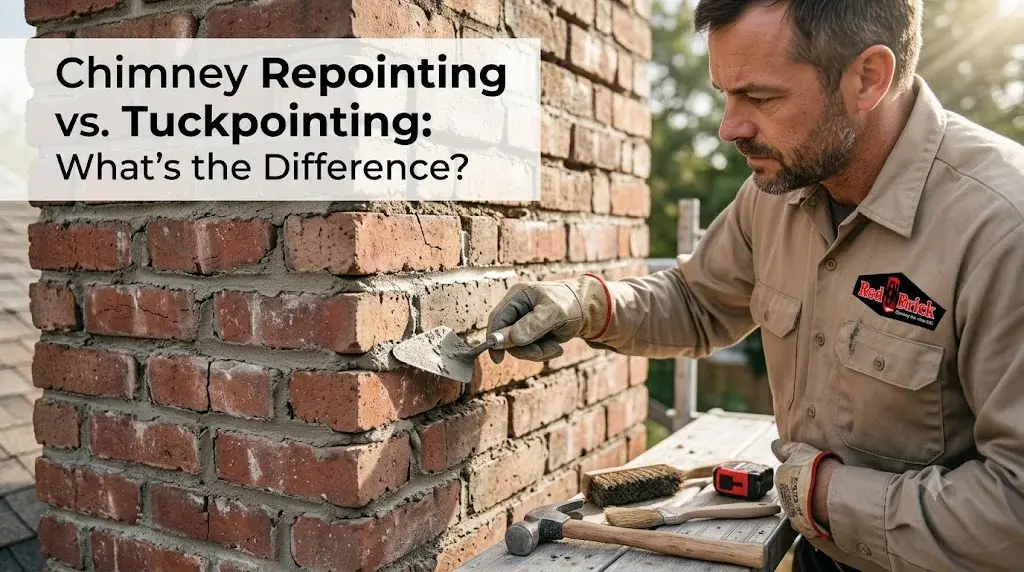
Repointing vs. tuckpointing in plain terms
Repointing is the process of cutting out deteriorated mortar and replacing it with new mortar. Its job is practical. Mortar joints take the brunt of the weather on a chimney, and once they crack, crumble or recede, rain soaks into the brick and the stack behind it.
Tuckpointing is a finishing technique built on top of repointing. The joint is filled with mortar tinted to match the brick, then a narrow ribbon of contrasting mortar, usually lighter, is applied down its centre. The result is a sharp, fine joint that makes older brickwork look neat and uniform.
So why the confusion? Across North America, “tuckpointing” has become shorthand for almost any mortar joint repair, and plenty of contractors use it that way. When you get a quote, ask whether it includes the contrasting mortar line and what mortar mix will be used. That one question clears up most misunderstandings.
| Repointing | Tuckpointing | |
|---|---|---|
| Main purpose | Restore weatherproofing and strength | Repair joints and add a decorative finish |
| Mortar | One, matched to the brick | Two: colour-matched fill plus contrasting line |
| Look | Natural, uniform joints | Crisp, high-contrast fine lines |
| Labour | Standard | Higher, because of the extra steps |
| Cost in Metro Vancouver | Baseline | About 15–20% more |
| Best for | Most chimneys | Visible or heritage chimneys where style matters |
How each is done
Both jobs begin the same way, and a good mason treats mortar removal as the most important step, not the most tedious one.
How chimney repointing is done
- Assess the chimney. The mason checks the brick, the hardness of the existing mortar and the overall condition of the stack. Cracked or spalled bricks are replaced before any new mortar goes in.
- Rake out the joints. Failed mortar is cut out with hand tools or a grinder, typically to a depth of about 12–25 mm (½ to 1 inch), without chipping the brick edges.
- Clean and dampen. Dust and debris are brushed out, and the brick is lightly wetted so it doesn’t pull moisture from the fresh mortar too quickly.
- Fill and tool. New mortar is packed in layers, then shaped into a profile that sheds water.
- Cure and clean. The joints are protected from drying out too fast, and excess mortar is cleaned off the brick face.
The mortar mix matters as much as the technique. Mortar should be softer than the brick around it, so the joint absorbs movement and wear instead of the brick. Many older homes across Metro Vancouver have soft brick laid in lime-based mortar, and filling those joints with a hard, cement-heavy mix can make the brick faces crack and flake. Our chimney mortar repair guide explains how mortar is matched to the age and type of brick.
How chimney tuckpointing is done
Tuckpointing follows steps one to three above, then adds:
- Fill with colour-matched mortar. Joints are filled flush with mortar tinted to blend with the brick.
- Cut a narrow groove. While the mortar is still workable, a thin channel is cut along the centre of each joint.
- Apply the contrasting line. A ribbon of lighter mortar is pressed into the groove and trimmed to a clean, even width.
- Check consistency. Line width and edges are checked across the whole face, because uniformity is what makes tuckpointing look right.
When tuckpointing makes sense on a chimney
Tuckpointing makes sense when appearance is part of the job, meaning the chimney is a visible feature and you want to keep or restore its original character. Common situations include:
- Heritage and character homes. Many older homes were built with fine joints that plain repointing won’t recreate.
- Street-facing chimneys. A chimney on the front elevation affects curb appeal more than one at the rear.
- Patchy earlier repairs. If past patching left mismatched joints, redoing the whole visible face gives a uniform finish.
- Work you’re already doing. The joints are being raked out anyway, so the finishing step is cheaper now than as a separate job later.
It makes less sense when the chimney is hidden, the budget is tight or the priority is simply to stop water getting in. In those cases, a clean, well-matched repoint gives you the same protection. The contrasting line is decorative; the protection comes from sound mortar packed deep into properly cleaned joints. Because tuckpointing should look consistent, it is usually applied across the entire visible face rather than in patches, which is part of why it costs more.
Neither technique is the answer if the stack is leaning, bricks are loose or the structure has shifted. That calls for a different conversation about chimney repair vs. rebuild. For the wider picture of brickwork repairs, see our brick chimney repair guide for Metro Vancouver.
Cost difference in Metro Vancouver (about 15–20% extra)
Across Metro Vancouver, tuckpointing generally costs about 15–20% more than a straightforward repoint on the same chimney. The difference is mostly labour: the second mortar, the groove and the careful trimming. Materials are a small part of it.
Several factors move the final price more than the technique does:
- Height and access. Taller or hard-to-reach chimneys may need scaffolding.
- Extent of damage. Deep or widespread mortar loss means more removal and more refilling.
- Brick repairs. Replacing damaged brick adds to the job.
- Mortar type. Lime-based mixes for older brick differ from standard mixes.
We keep detailed pricing in its own article so you can compare real ranges; the cost guide linked at the top of this page covers it. Wondering whether a policy might help with the bill? Read does home insurance cover chimney repair in Vancouver.
Which one does your chimney need?
Start with the condition of the mortar, not the finish. These signs mean the joints need attention, whichever technique you choose:
- Crumbling, sandy or powdery mortar
- Joints that are recessed or visibly gapped
- Hairline cracks running along the joints
- White, chalky staining on the brick
- Moss or damp patches on the stack
- Loose or shifting bricks
The wet coastal climate across Metro Vancouver speeds all of this up, as we explain in how Vancouver’s rainy climate damages chimneys faster.
Then decide:
- Choose repointing if the goal is to stop water getting in, the budget matters, the chimney isn’t prominent or the existing joints are plain.
- Choose tuckpointing if the original joints had a fine-line look, the chimney is a visible feature or curb appeal is a priority.
- Check something else first if the leak seems to start at the base, the top or the roofline. Cracked crowns, failed flashing and damaged caps often get blamed on the mortar. Look at chimney crown replacement, counter-flashing repair or our leak around chimney diagnostic guide.
If you can’t tell from the ground, a chimney inspection will show what’s failing and why. Mortar work goes best in a dry, mild window, so see the best time of year for chimney repair in Vancouver. Whoever you hire, our guide on how to hire a masonry contractor lists the questions worth asking, and you can browse finished jobs in our gallery.
Repointing vs. tuckpointing FAQ
Is tuckpointing the same as repointing?
Not technically. Repointing replaces failed mortar to restore weatherproofing. Tuckpointing does that too, then adds a contrasting mortar line for a decorative finish. In everyday conversation, though, many masons use the words interchangeably, so always confirm exactly what a quote includes.
Which is better for a chimney, repointing or tuckpointing?
For protection, they perform about the same when done properly with the right mortar. Repointing is the practical choice for most chimneys. Tuckpointing is better when appearance and original style matter, such as on heritage homes or chimneys visible from the street.
Is tuckpointing only cosmetic?
The contrasting line is cosmetic, but the mortar fill beneath it still seals the joint, provided the old mortar was fully removed first. A tuckpointing job that skips proper preparation is only a surface finish over a failing joint, so ask how deep the joints will be raked out.
How long does chimney repointing last?
Well-done work using mortar compatible with the brick can last many years, often decades. Exposure, brick condition and the state of the crown and flashing all affect that. A cracked crown or failed flashing will shorten the life of any mortar repair.
How do I know if my chimney needs repointing?
Look for crumbling or recessed mortar, gaps, hairline cracks, white staining, moss or loose bricks. Binoculars from the ground can help, but a roof-level inspection is more reliable because damage is often worst at the top, where exposure is greatest.
Can I repoint or tuckpoint a chimney myself?
We don’t recommend it. Working at roof height is dangerous, and using the wrong mortar or grinding too aggressively can permanently damage the brick. Chimney work is better left to an experienced mason with the right access equipment.
Can chimney mortar work be done in winter or in the rain?
Mortar needs mild, dry conditions to cure properly, and cold or wet weather can weaken it. In the Lower Mainland, the dry stretch from late spring to early fall is the easiest window, though short mild breaks in winter can sometimes work.
How much more does tuckpointing cost than repointing in Metro Vancouver?
Tuckpointing typically adds about 15–20% on top of a repoint of the same chimney, mainly because of the extra labour. The total depends on chimney height, access and how much mortar needs replacing, so the cost guide linked above has the detail.
Areas we serve
The techniques in this guide apply across our service area, though the age and style of the housing stock changes from one city to the next. Red Brick Masonry works throughout Metro Vancouver, including Vancouver, Burnaby, Coquitlam, New Westminster, Port Moody, Richmond and Surrey, as well as Port Coquitlam. Visit your city’s page for local details on chimney work in your area.
Get a straight answer for your chimney
Not sure whether your chimney needs repointing, tuckpointing or something else entirely? Red Brick Masonry looks at the whole stack, not just the mortar, so the recommendation matches what the chimney actually needs. Contact our team for an assessment, or see our chimney repair services and chimney repair in Vancouver.