

If your chimney is made of brick, its problems are almost never “chimney problems” in the generic sense — they’re masonry problems. Cracked mortar, spalling brick, a leaning stack: these all come down to how brick and mortar behave when they’re soaked, frozen, and soaked again, winter after winter, in a coastal climate. That’s why brick chimney repair is really a specialized branch of masonry work, not general handyman territory, and why the contractor you hire matters more than most homeowners realize.
This guide walks through what brick chimney repair actually involves, the warning signs specific to masonry damage, how it differs from working on a stone or metal chimney, and what a professional mason does differently from a general roofer. If you’re trying to figure out whether that crack in your chimney is cosmetic or serious, you’ll find the answer here — along with what happens next if it isn’t.
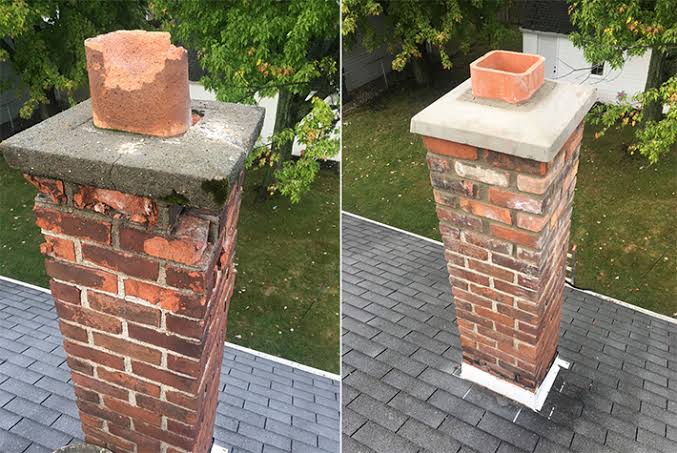
What Is Brick Chimney Repair, Exactly?
Brick chimney repair covers any work that restores the structural or weatherproof integrity of a brick masonry chimney. That’s a broader category than most homeowners expect. It includes:
- Repointing (tuckpointing): removing crumbled mortar joints and replacing them with fresh, matched mortar
- Brick replacement: swapping out individual bricks that have spalled, cracked, or crumbled
- Crown and cap repair: fixing the concrete cap and metal cover that keep water out of the flue
- Flashing repair: resealing the metal junction where brick meets your roofline
- Structural stabilization: correcting a leaning or bulging chimney stack
- Partial rebuilds: reconstructing the section above the roofline, which takes the brunt of weather exposure
The common thread is that all of it is masonry work. A general chimney repair might also involve the flue liner, damper, or firebox — mechanical components inside the chimney. Brick chimney repair specifically deals with the exterior structure: the brick, the mortar, and everything that keeps water from getting between them.
Signs Your Brick Chimney Needs Repair
Brick and mortar fail slowly, then all at once. These are the signs worth acting on before that happens:
- Crumbling or missing mortar joints — you can often see daylight or gaps between bricks from the ground
- Spalling bricks — the face of the brick is flaking, chipping, or peeling away
- White chalky residue (efflorescence) on the brick surface, which signals water is moving through the masonry
- Cracks in the brick itself, especially stair-step cracks running diagonally up a wall or stack
- A visibly leaning or tilting chimney — never cosmetic, always structural
- Loose bricks that shift or wobble when gently tested
- Discoloration or dark staining, particularly along the shoulders of the chimney where water pools
- Interior water stains on ceilings or walls near the chimney, which usually trace back to failed mortar or flashing rather than the roof itself
Any one of these on its own is worth a look. Two or more together usually means the damage has been progressing for a while, and it’s worth a full assessment rather than a spot fix. Our 5 signs your chimney needs repair breaks these down in more depth, with photos and examples from homes across the region.
Why Metro Vancouver’s Climate Is Hard on Brick and Mortar
Brick masonry is porous by design — it needs to breathe. That’s fine in a dry climate. It’s a liability in one that gets over 1,100mm of rain a year, plus regular freeze-thaw cycles through the winter. Here’s the mechanism:
- Rain soaks into brick and mortar joints.
- Overnight temperatures drop below freezing.
- The trapped water expands as it freezes, putting outward pressure on the brick and mortar.
- Micro-cracks form. Repeat this cycle for a few seasons, and those micro-cracks become the spalling, crumbling, and cracking described above.
This is exactly why the region’s rainy climate damages chimneys faster than it would somewhere drier — and why brick chimney repair across Metro Vancouver tends to be a recurring maintenance item rather than a one-time fix. A well-repointed chimney with proper flashing and a working cap can go 20-25 years between major repairs. One that’s been neglected can develop serious structural issues within a decade.
Brick vs. Stone Chimney Repair: Does the Material Change the Approach?
Most chimneys in Metro Vancouver’s older housing stock are clay brick, but a meaningful number are natural stone, especially in character and heritage homes. The repair principles overlap — both rely on mortar joints to hold units together, and both fail through moisture infiltration — but the execution differs:
- Brick is uniform in size and shape, which makes replacement more straightforward. Matching the color and texture of older brick is the main challenge, since brick manufacturing and weathering change its appearance over decades.
- Stone is irregular, and each piece is effectively unique. Stone chimney repair generally requires more hand-fitting, and sourcing a matching stone (or salvaging one from the original structure) takes more time than ordering brick.
- Mortar mix needs to match the hardness of the surrounding material in both cases. This is one of the most common mistakes in DIY and low-quality repairs: using a mortar that’s harder than the brick or stone around it. Hard mortar doesn’t flex with freeze-thaw movement, so the brick — not the mortar — takes the damage and starts to crack instead.
Whether you’re dealing with brick, stone, or a mixed-material chimney, the mason doing the work needs to identify the original mortar composition before mixing a repair batch. Getting this wrong accelerates the exact damage you’re trying to fix.
DIY vs. Hiring a Professional Mason
It’s tempting to treat a few loose bricks as a weekend project, and for very minor cosmetic work, that’s sometimes reasonable. But brick chimney repair sits at the intersection of two risks that make professional work worth the cost for anything beyond the superficial:
Height risk. Chimneys are, by definition, at roof level. Falls from roof height are a leading cause of serious home-repair injuries, and most homeowners don’t have the harness, ladder rating, or roof-anchor setup that a licensed contractor uses as standard practice.
Structural risk. A chimney isn’t decorative — it’s a masonry structure with real weight, sitting above your living space. Repointing with the wrong mortar mix, or patching over a crack without addressing what’s causing it, can mask a structural problem instead of solving it. That’s how a $700 repair turns into a $6,000 rebuild two years later.
A qualified chimney repair mason will:
- Inspect beyond the visible symptom to find the underlying cause
- Match mortar composition and brick appearance to the existing structure
- Know when a repair is legitimate and when a section actually needs rebuilding
- Carry WorkSafeBC coverage and proper fall-protection equipment
- Provide a written estimate that separates labour and materials
If you’re comparing quotes, ask specifically about masonry experience — not just general roofing or handyman work. Chimney and general masonry repair require different skills than asphalt shingles or gutters, and a contractor who’s strong in one isn’t automatically qualified in the other.
The Chimney-Roof Connection: Why Roofing and Masonry Work Together
A lot of homeowners searching for “roofing and chimney repair near me” are really dealing with one specific failure point: the flashing where the chimney meets the roof. This junction is where two very different materials — brick masonry and roofing membrane — have to form a watertight seal, and it’s one of the most common sources of leaks in older Metro Vancouver homes.
When flashing fails, water doesn’t just damage the roof deck around the chimney — it travels down the brick face and into the mortar joints, accelerating the freeze-thaw damage described earlier. That’s why a proper roof and chimney repair often needs to address both the roofing material and the masonry at the same time; fixing one without the other just relocates the leak. If your contractor only touches the shingles or only touches the brick, ask whether the flashing itself was inspected — it’s the piece most often overlooked.
What to Expect From a Professional Repair
A typical brick chimney repair, once damage is confirmed, follows a consistent sequence:
- Inspection — visual assessment from the ground, followed by a closer look at the crown, flashing, and mortar joints, often including photos taken at height
- Diagnosis — identifying whether the issue is isolated (a section of repointing) or systemic (a leaning stack, widespread spalling)
- Material matching — sourcing brick, stone, or mortar that matches the existing structure in colour, texture, and hardness
- Removal and preparation — carefully removing damaged brick or mortar without disturbing sound material
- Repair execution — repointing, brick replacement, crown resealing, or flashing reinstallation, depending on scope
- Finishing and cleanup — cleaning excess mortar, matching the joint profile, and clearing debris
For a full breakdown of our step-by-step process, see our chimney inspection process page.
How Much Does Brick Chimney Repair Cost?
Costs vary widely depending on scope — a small repointing job is a very different price than a partial rebuild. In general, Metro Vancouver homeowners should expect:
- Minor repointing or mortar repair: $500 – $3,500
- Spalling brick replacement: $1,000 – $3,500
- Flashing repair: $300 – $1,800
- Partial rebuild (above roofline): $1,000 – $5,000
- Full rebuild: $5,000 – $10,000+
For a complete cost breakdown by repair type, including what affects pricing and how to budget for hidden costs like permits and scaffolding, see our full Chimney Repair Cost in Vancouver: 2026 Guide.
When Brick Chimney Damage Becomes an Emergency
Most masonry damage develops slowly, but a few situations call for immediate attention rather than scheduling a routine appointment:
- A chimney that’s visibly leaning or has shifted noticeably
- Large sections of brick that have fallen or are actively falling
- A storm has struck the chimney with debris, or high winds have dislodged brick or flashing
- You can see daylight through cracks from inside an attic space
If any of these apply, don’t wait — read our guide on emergency chimney repair after a storm and get an inspection scheduled right away. A structurally compromised chimney is a safety hazard, not just a maintenance item.
Repair or Rebuild?
Not every masonry problem needs a full rebuild, and not every crack is worth ignoring either. As a general rule:
- Repair when damage is isolated to a section of mortar, a few bricks, the crown, or the flashing, and the underlying structure is sound.
- Rebuild when the lean is structural, the flue liner has failed alongside the masonry, or repeated repairs are starting to approach the cost of starting fresh.
We cover this decision in more detail in Chimney Repair vs. Rebuild, including how to read a written estimate so you’re comparing both options honestly.
Finding a Brick Chimney Repair Contractor Near You
Red Brick Chimney Services has been repairing brick, stone, and masonry chimneys across Metro Vancouver since 2013, with rapid-response service throughout Vancouver, Burnaby, Surrey, Richmond, New Westminster, Port Moody, and Port Coquitlam. Because we specialize in masonry rather than general roofing, our assessments focus specifically on what brick, mortar, and stone are telling you — not just what’s visible from the ground.
Whether you’re dealing with spalling brick in Surrey, a cracked crown in Richmond, or a leaning stack in Burnaby, the process starts the same way: a proper inspection, an honest diagnosis, and a written estimate that explains exactly what’s being repaired and why.
Frequently Asked Questions
What is the difference between chimney repair and masonry chimney repair?
Chimney repair can include mechanical components like the liner, damper, or firebox. Masonry chimney repair specifically addresses the brick, stone, and mortar that make up the exterior structure — repointing, brick replacement, crown work, and structural stabilization.
How do I know if my chimney crack is serious?
Horizontal cracks, stair-step cracks, and any crack wider than about 6mm (1/4 inch) generally indicate structural movement rather than surface weathering. A visible lean, checked with a string line from cap to base, is always worth a professional assessment.
Can I repoint my own chimney?
Basic cosmetic touch-ups are within reach for a confident DIYer, but full repointing requires matching mortar hardness to the existing brick, working safely at height, and recognizing when a “small” crack is actually a symptom of something larger. A mismatched mortar mix can accelerate brick damage rather than prevent it.
Is brick chimney repair covered by home insurance?
It depends on the cause. Sudden damage from a storm or falling debris is more likely to be covered than gradual deterioration from age or weather, which most BC insurers treat as a maintenance issue. Check your specific policy and document any storm-related damage with photos.
How often does a brick chimney need repair in Metro Vancouver?
There’s no fixed schedule, but annual inspection is the standard recommendation given the region’s rainfall. Quality repointing typically lasts 20-25 years; caps and crowns can last 15-20 years or more if properly maintained.
Brick chimney damage rarely gets better on its own, and in a climate that cycles through rain and freezing temperatures all winter, small cracks don’t stay small for long. If you’ve spotted any of the warning signs above, get in touch for a free inspection — we’ll tell you honestly whether you’re looking at a repair or something more.