

If you’ve just found a crack in your chimney’s crown, a leaning stack after a windstorm, or water stains spreading across your ceiling, the cost of repair is probably the first thing on your mind — and the first question most homeowners ask is whether their home insurance will pay for it. The honest answer is: it depends entirely on what caused the damage.
Home insurance in Vancouver generally covers chimney repair when the damage results from a sudden, specific event — a chimney fire, a lightning strike, a fallen tree, or a windstorm. It does not cover chimney repair caused by age, weather-related wear, or a lack of regular maintenance, which unfortunately describes most of the chimney damage local homeowners actually deal with. Vancouver’s near-constant rain and freeze-thaw cycles make that second category especially common here, which is exactly why understanding the distinction matters more in this climate than almost anywhere else in Canada.
This guide breaks down exactly which chimney repairs your home insurance is likely to cover, which ones you’ll pay for out of pocket, and what BC homeowners can do — including keeping WETT inspection records — to give a legitimate claim the best possible chance of being approved.
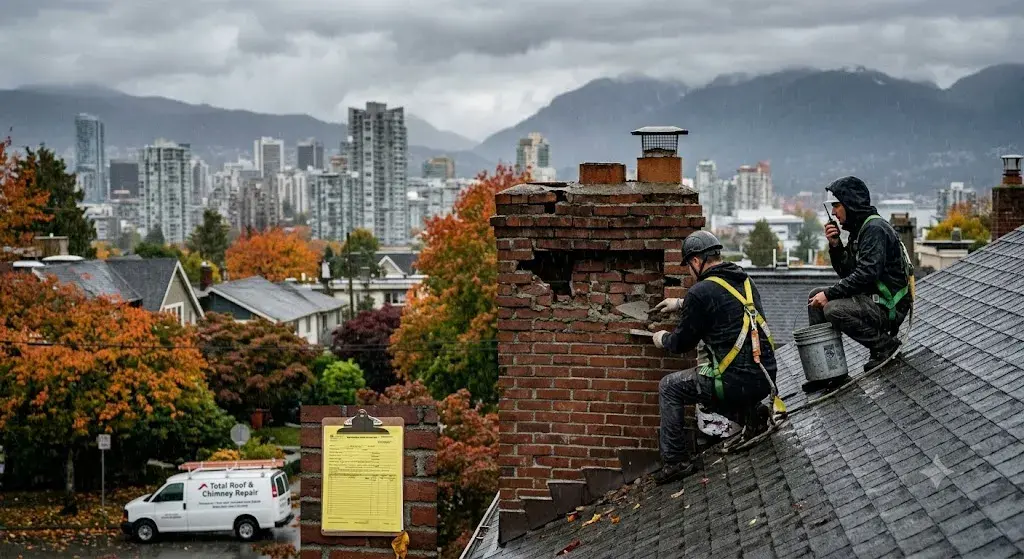
The Short Answer: Coverage Depends on the Cause, Not the Damage Itself
Every standard home insurance policy in BC includes dwelling coverage, which protects the physical structure of your home — including the chimney — against covered perils. A covered peril is a specific, named cause of loss: fire, lightning, wind, falling objects, and similar sudden events. If your chimney is damaged by one of these, home insurance typically covers chimney repair, minus your deductible.
What a standard policy does not cover is deterioration. Insurers draw a hard line between something that happened to your chimney and something that simply happened over time. A brick chimney that slowly develops cracked mortar joints over ten wet Vancouver winters isn’t an insurance claim — it’s maintenance, and it’s the homeowner’s responsibility.
When Home Insurance Typically Covers Chimney Repair
These are the scenarios where a chimney damage insurance claim is most likely to succeed:
- Chimney fire: An unexpected fire caused by a wood stove or fireplace is one of the most commonly approved chimney fire insurance claims — provided the chimney had been reasonably maintained beforehand.
- Lightning strikes: Chimney damage from a lightning strike, including cracked or displaced masonry, is almost always covered under a standard policy.
- Falling trees or branches: If a storm brings down a tree or large limb onto your chimney, both the chimney repair and the tree removal are typically included.
- Wind storm damage: BC’s autumn and winter windstorms can qualify for coverage, though insurers will usually want confirmation the chimney wasn’t already compromised before the storm hit.
- Ice or snow collapse: Sudden collapse from the weight of ice or snow is generally covered, as long as the collapse wasn’t the end result of long-term deterioration.
- Vehicle impact: If a vehicle strikes your chimney, the damage is usually covered — sometimes under your policy, sometimes under the driver’s.
Here’s how the most common causes of chimney damage in Vancouver typically shake out:
| Cause of Damage | Usually Covered? | Notes |
|---|---|---|
| Chimney fire (unexpected) | Yes | Sudden fires from a fireplace or wood stove are typically covered. Insurers may still check maintenance and sweep records. |
| Lightning strike | Yes | One of the most reliably covered perils, including cracked or leaning masonry caused by a strike. |
| Falling tree or branch | Yes | Storm-driven tree damage to the chimney is generally covered, along with tree removal costs. |
| Wind storm damage | Often | BC windstorms and atmospheric rivers can qualify, but insurers may require proof the damage wasn’t pre-existing. |
| Ice or snow collapse | Often | Covered if the weight of ice or snow causes sudden collapse — not if the chimney was already deteriorating. |
| Vehicle impact | Yes | Usually covered, though the driver’s insurance may also be involved. |
| Wear and tear / age | No | Standard exclusion across nearly every BC insurer. This covers most repointing, spalling, and crown deterioration. |
| Lack of maintenance / neglect | No | Insurers may request maintenance records; missing them can jeopardize an otherwise valid claim. |
| Pre-existing damage | No | Damage documented (or reasonably detectable) before the loss event is excluded. |
| Gradual water infiltration | No | Slow leaks through flashing or a cracked crown are treated as a maintenance issue, not a sudden event. |
This table reflects general BC industry practice, not any single insurer’s wording — always confirm specifics against your own policy documents.
When Home Insurance Won’t Cover Chimney Repair
This is the part most homeowners don’t find out until they’re mid-claim. Chimney repair is not covered by insurance in the following situations:
- Wear and tear: The single biggest insurance exclusion for chimneys. Repointing, spalling brick, and a deteriorating crown almost always fall under this category — and they’re also the most common repairs on the Lower Mainland.
- Lack of maintenance: If an insurer determines that regular sweeping or inspection would have caught the problem earlier, they can deny the claim on neglect grounds.
- Pre-existing damage: Damage that existed — or reasonably should have been noticed — before a storm or fire event isn’t covered by that event’s claim.
- Gradual water infiltration: A slow leak through aging flashing or a hairline crack in the crown is treated as a maintenance issue, not a sudden loss, even though the resulting damage can be extensive.
- Masonry-only exclusions: Some BC policies separate the chimney’s brick or stone exterior from the flue and structure underneath, and the masonry itself may need a separate rider to be covered at all. It’s worth asking your broker directly whether your policy draws this line.
Why Vancouver’s Climate Makes This Distinction So Important
This split between covered perils and gradual wear matters more here than in drier parts of the country. As we’ve covered in more depth in how Vancouver’s rainy climate damages chimneys faster, the Lower Mainland’s near-constant rainfall and repeated freeze-thaw cycles accelerate mortar breakdown and brick spalling well beyond what insurers typically classify as sudden or accidental. That means a large share of chimney repair Vancouver homeowners actually need falls squarely into the excluded category — not because insurers are being difficult, but because the underlying cause genuinely is gradual weather exposure rather than a single event.
The same applies to active leaks. If you’re dealing with water coming in around the fireplace, it’s worth understanding what’s actually causing the leak before assuming insurance will pick up the bill — a cracked crown or failed flashing that’s been slowly letting water in for a season or two is a maintenance claim, not an insurance one.
Why WETT Documentation Matters for Your Insurance Claim
This is where BC homeowners have a real advantage most people don’t use. A WETT (Wood Energy Technology Transfer) inspection is a certified, dated record of your chimney’s condition at a specific point in time. That documentation does two things for an insurance claim:
- It gives an adjuster concrete proof of your chimney’s condition before the loss event — making it much harder for an insurer to argue the damage was pre-existing.
- It demonstrates ongoing maintenance, which directly counters the most common reason chimney claims get denied in the first place.
If you don’t have a recent WETT inspection or sweep record on file, scheduling a professional chimney inspection now — before you need to file a claim — is one of the most useful things you can do. It costs a fraction of what a denied claim ends up costing, and it creates the paper trail an insurer will ask for regardless of which peril eventually causes the damage.
How to Strengthen a Chimney Insurance Claim
If your chimney has just been damaged, the way you document it in the first 24–48 hours has a real effect on whether the claim gets approved:
- Photograph everything immediately: Wide shots and close-ups, from the ground and from the roof if it’s safe to do so, dated automatically by your phone.
- Get a professional damage assessment: An inspection report from a licensed mason carries far more weight with an adjuster than a homeowner’s own description of the damage.
- Pull your maintenance history: Past sweep receipts, inspection reports, and any prior repair invoices help establish that the chimney was reasonably maintained.
- Report storm or fire damage quickly: Don’t wait. If your damage followed a storm, see our guide on emergency chimney repair after a storm for what to do in the first 24 hours.
For storm-related damage specifically, our guide on emergency chimney repair after a storm walks through exactly what to check and document before a contractor arrives.
What About Strata and Condo Buildings?
If you live in a strata or condo building, chimney and fireplace coverage usually runs through the strata corporation’s master policy rather than your individual homeowner’s policy — though who pays what deductible, and whether interior damage is covered separately, varies by strata bylaws and the specific policy in place. If you’re dealing with chimney damage in a strata building, your first call should be to the strata council or property manager to confirm which policy applies before you assume either coverage or exclusion.
Repair Costs You’ll Likely Pay Out of Pocket
Because most everyday chimney problems fall under the wear-and-tear exclusion, it’s worth budgeting for them separately from any insurance conversation. Our 2026 chimney repair cost guide for Vancouver breaks down real current pricing for the repairs insurers most commonly decline — repointing, crown repair, flashing replacement, and spalling brick — so you can budget accurately rather than assuming a claim will cover it.
What to Do If Your Chimney Needs Repair Right Now
Whether your damage turns out to be a covered peril or a maintenance issue, the first step is the same: get a professional assessment before you file a claim or book a repair. An accurate, documented inspection protects you either way — it supports a legitimate claim, and it stops you from overpaying for work you don’t need. If you’re anywhere in Vancouver or the surrounding Lower Mainland, our team can inspect your chimney, document the damage in a format insurers recognize, and walk you through what’s realistically covered before any work begins.
Frequently Asked Questions
Does home insurance cover a leaking chimney in Vancouver?
Sometimes. If the leak was caused by a sudden event — a storm-damaged flashing or a lightning-cracked crown — it’s usually covered. If the leak developed gradually through aging mortar or a slowly failing crown, which is common in Vancouver’s climate, it’s treated as a maintenance issue and typically isn’t covered.
Does insurance cover chimney fire damage?
Yes, in most cases. A chimney fire insurance claim from an unexpected fire is one of the more reliably approved claims, though insurers may review your sweep and maintenance history as part of the assessment.
Does home insurance cover a leaning or collapsing chimney?
It depends on the cause. A chimney that collapses suddenly under the weight of ice or snow, or leans after a lightning strike, is generally covered. A chimney that gradually leans due to eroded mortar or foundation settlement over years is considered wear and tear, and isn’t.
Will my insurer deny a claim if my chimney hasn’t been inspected recently?
It can work against you. Insurers frequently request proof of maintenance when assessing a chimney damage claim, and the absence of any inspection or sweep history makes it easier for them to argue the damage was neglect-related rather than sudden.
Does home insurance cover a full chimney rebuild?
Only if the damage that necessitated the rebuild stemmed from a covered peril — a major storm, fire, or lightning strike, for example. A rebuild required because of long-term structural deterioration is not covered, since the underlying cause is wear and tear, not a single event.
What is WETT and how does it affect my insurance claim?
WETT (Wood Energy Technology Transfer) certification is a recognized Canadian standard for wood-burning appliance and chimney inspections. A dated WETT inspection report gives you documented proof of your chimney’s condition before a loss event, which materially strengthens a claim by making it harder for an insurer to dispute when the damage occurred.
How do I file a chimney damage insurance claim?
Document the damage with photos immediately, get a professional inspection report from a licensed chimney or masonry contractor, gather any past maintenance records, and contact your insurance provider promptly — most policies require timely reporting. Your broker can confirm what your specific policy requires.
Final Thoughts
Home insurance covers chimney repair in Vancouver when the damage traces back to a specific, sudden event — fire, lightning, storms, or falling debris. It does not cover the slow deterioration that Vancouver’s rain and freeze-thaw cycles cause in most chimneys over time, which is why maintenance records and a documented inspection history matter as much as the policy itself. Before assuming either outcome, get a professional assessment: it tells you honestly which category your damage falls into, and it’s the strongest piece of documentation you can hand an adjuster either way.
This article is intended as general information, not insurance advice — always confirm coverage details directly with your insurance provider or broker, since policy wording varies between insurers.