
Buying a home with a fireplace? Renewing your insurance? Chances are someone has told you that you need a “WETT inspection” or a “chimney inspection.” Many Metro Vancouver homeowners assume these are the same service with two names. They’re not, and booking the wrong one can delay a home purchase or leave your insurer unsatisfied.
This guide explains what each inspection covers, where they overlap, and which one you actually need.
The Short Answer
A chimney inspection assesses the condition of your chimney system: masonry, flue liner, crown, cap and flashing. A WETT inspection checks whether a wood-burning appliance and its chimney connection are installed safely and to code, and it is the report most insurers ask for. Many homes with a wood-burning fireplace or stove benefit from both.
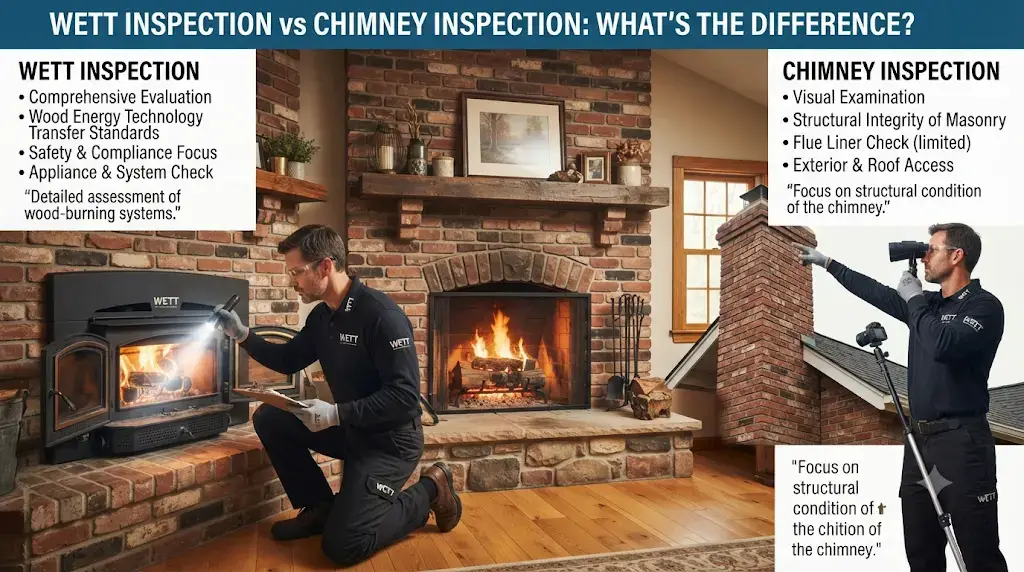
WETT Inspection vs Chimney Inspection at a Glance
| Chimney Inspection | WETT Inspection | |
| Main question answered | Is the chimney sound, and what needs repair? | Is the wood-burning appliance installed safely and to code? |
| Focus | Chimney structure and flue | Appliance, clearances, hearth, chimney connector, flue |
| Reference standard | NFPA 211 inspection levels (Level 1-3) | CSA B365 installation code and local building code |
| Typically requested by | Homeowners, buyers, contractors | Insurance companies, home buyers, lenders |
| Done by | Chimney technician or inspector | WETT Certified Inspector |
| Result | Findings, photos, repair recommendations | Report documenting compliance and deficiencies |
| Best for | Leaks, aging masonry, annual safety, before repairs | Insurance, pre-purchase, new or changed stove installs |
What Is a Chimney Inspection?
A chimney inspection evaluates the health of the entire chimney system, from the firebox up through the flue to the crown and cap. The goal is to find damage, blockages and hazards before they turn into fires, leaks or costly repairs.
Chimney inspections are commonly grouped into three levels, based on NFPA 211:
- Level 1: a visual check of readily accessible areas. It suits an annual check on a chimney that’s used regularly with no known problems.
- Level 2: everything in Level 1, plus a video camera scan of the flue and inspection of attic and crawl-space areas. It’s typically recommended when you buy or sell a home, change fuel type, or after an event like a chimney fire or storm.
- Level 3: an in-depth inspection that may involve removing components or opening walls to reach hidden problems when a serious hazard is suspected.
A thorough inspection looks at:
- Brickwork, mortar joints, spalling and leaning
- Flue liner cracks, gaps and deterioration
- Chimney crown condition
- Chimney caps, pots and pest screens
- Counter flashing where the chimney meets the roof
- Damper operation, smoke chamber and firebox
- Creosote buildup, blockages and animal nests
- Clearances to nearby combustible materials
In Vancouver’s wet climate, moisture is the most common culprit behind chimney damage, so a good inspection pays close attention to the crown, flashing and mortar. See our full breakdown of the chimney inspection process for what to expect on the day.
What Is a WETT Inspection?
WETT stands for Wood Energy Technology Transfer, a Canadian training and certification body for professionals who work with wood-burning systems. A WETT inspection is a safety and code-compliance check of a wood-burning appliance, such as a wood stove, fireplace, fireplace insert, pellet stove or wood furnace, and the parts connected to it.
A certified WETT inspector typically checks:
- Appliance installation: is it installed according to the manufacturer’s instructions and applicable codes?
- Clearances: is there enough space between the appliance, its connector pipe and combustible materials such as walls, ceilings and mantels?
- Hearth and floor protection: is the non-combustible protection the right size and material?
- Chimney connector: is the pipe between stove and chimney correctly sized, supported and sealed?
- Chimney and flue suitability: is the chimney appropriate for the appliance, and does the flue appear intact?
- Other hazards: venting, signs of overheating, missing components and unapproved modifications.
The inspector then provides a written report that notes any deficiencies. That report is what insurers, buyers’ agents and lenders ask for.
Good to know: WETT certifies individuals, not companies. Ask for the inspector’s certification number and make sure it appears on the report. If you need the report for insurance, confirm that the inspector holds the WETT Certified Inspector designation, since some insurers won’t accept anything less.
Key Differences Between a WETT Inspection and a Chimney Inspection
1. They answer different questions
A chimney inspection asks “What condition is this chimney in?” A WETT inspection asks “Is this wood-burning setup installed safely and to code?” A chimney can be structurally fine yet fail a WETT inspection because the stove sits too close to a wall. The reverse is also true: a perfectly installed stove can be connected to a chimney with a cracked liner.
2. They focus on different components
Chimney inspections concentrate on the chimney itself, including masonry, liner, crown, cap and flashing. WETT inspections concentrate on the appliance and its installation, including clearances, hearth, connector and venting.
3. They serve different audiences
Homeowners and contractors book chimney inspections to plan maintenance and repairs. WETT inspections are usually triggered by a third party. Most Canadian insurers want a WETT inspection before covering a home with a wood-burning appliance, and in BC it is one of the most common insurance conditions for homes with wood stoves.
4. The deliverable is different
A chimney inspection leads to repair recommendations and cost estimates. A WETT report documents code compliance and lists what has to be corrected to satisfy an insurer.
5. Gas and electric units are handled differently
WETT applies to solid-fuel (wood, pellet) appliances. Gas fireplaces fall under different rules and are generally serviced and inspected by a licensed gas contractor, not through a WETT inspection.
Where the Two Inspections Overlap
Both inspections look at the flue, clearances and general safety, and both can uncover fire hazards. That overlap is why people confuse them. It’s also why combining them can save time: one visit can cover chimney condition and appliance compliance, giving you a single point of contact for repairs.
Which One Do You Need?
You’re buying a home with a wood stove or fireplace.
Get both if you can. A WETT inspection protects you against code and insurance surprises, and a Level 2 chimney inspection with a camera scan reveals hidden flue damage that a visual check will miss. Pre-purchase findings are also useful for negotiating repairs or price. See our guide to pre-purchase chimney inspections.
Your insurer asked for an inspection.
Ask them exactly what they require. For wood stoves, inserts and fireplaces, that’s usually a WETT inspection by a certified inspector. If the report flags chimney issues, a chimney inspection and repair plan is the next step. For related reading, see does home insurance cover chimney repair.
You’re seeing leaks, crumbling brick or a leaning chimney.
You need a chimney inspection. These are masonry and water-entry problems, not appliance-compliance issues. Start with our leak around chimney diagnostic guide or chimney repair services.
You’re installing a new stove or changing fuel types.
You need a WETT inspection of the installation, and likely a chimney inspection to confirm the existing flue suits the new appliance.
You’ve had a storm, chimney fire or earthquake.
Book a chimney inspection first (Level 2 is typically recommended). Our article on emergency chimney repair after a storm explains what to look for.
Your chimney hasn’t been used in years.
Start with a chimney inspection. Unused chimneys still deteriorate, collect debris and attract animals.
You’re selling your home.
A chimney inspection report lets you fix or disclose problems before buyers find them. If you have a wood stove, a current WETT report may speed up the sale.
How Much Do They Cost in Metro Vancouver?
Prices vary by home, access, appliance type and inspection level.
For chimney inspections at Red Brick Chimney Services, typical ranges are:
- Level 1: 150-250 (often included with a chimney sweep)
- Level 2 with video scan: 300-500
- Pre-purchase inspection: 300-500
- Insurance-related inspection: 200-400
- Level 3: 500-1,500+
WETT inspection pricing depends on how many appliances are inspected and how complex the installation is. Ask for a quote that spells out what’s included. For a deeper look at pricing, read our chimney inspection cost guide for Vancouver. If you also need cleaning, compare chimney sweep costs.
What Happens If You Fail a WETT Inspection?
A “fail” isn’t the end of the road. The report lists the deficiencies. Common examples include insufficient clearances, inadequate hearth protection, damaged or incorrect connector pipe, and a cracked or unsuitable flue. Once those are corrected, you can usually have the unit re-inspected and provide the updated report to your insurer.
Where the issue is masonry-related, such as a cracked crown, failed flashing, loose bricks or a deteriorated liner, Red Brick’s team handles chimney masonry repairs, crown replacement and chimney reconstruction when repair isn’t enough. If the firebox itself is damaged, see firebox repairs and rebuilds.
How to Choose the Right Inspector
- Check credentials. For a WETT inspection, ask for the inspector’s WETT certification number.
- Ask what’s included. Does the price cover a camera scan, photos and a written report?
- Confirm turnaround. Real estate deadlines are tight. Red Brick delivers inspection reports within 24-48 hours.
- Look for local experience. Metro Vancouver’s rain, older brick homes and seismic activity create specific chimney problems.
- Beware of upselling. A good inspector explains severity and priorities, and doesn’t pressure you into unnecessary work.
For a deeper checklist, see how to choose a chimney sweep and who to call for chimney repair.
Frequently Asked Questions
Is a WETT inspection the same as a chimney inspection?
No. A WETT inspection checks that a wood-burning appliance and its connection are installed safely and to code. A chimney inspection assesses the condition of the chimney itself. They overlap on flue and clearance checks, but they answer different questions.
Do I need a WETT inspection to buy a house in BC?
It isn’t a blanket legal requirement for every purchase, but insurers commonly require one before covering a home with a wood stove or fireplace. Buyers often make it a condition of the offer. Check with your insurance provider before you finalize your purchase.
Does home insurance require a WETT inspection in BC?
Often yes, for homes with wood stoves, inserts, pellet stoves and some fireplaces. Requirements vary by insurer, so confirm with yours which inspection level and credentials they accept.
Can a chimney sweep do a WETT inspection?
Only if the individual is a WETT Certified Inspector. Chimney sweeps and masons can perform chimney inspections, but a WETT report must come from a certified WETT inspector.
How often should I have my chimney inspected?
Annually for actively used wood-burning chimneys, and any time you buy a home, change fuel type, or experience a chimney fire, storm damage or leak. Learn more about how often to schedule a chimney sweep.
Do I need an inspection if I rarely use my fireplace?
Yes. Even unused chimneys develop cracks, water damage and animal nests, and these problems can go unnoticed until you light your first fire of the season.
The Bottom Line
If you want to know whether your chimney is sound, book a chimney inspection. If you need to prove your wood stove or fireplace is installed safely and to code, usually for insurance or a home sale, book a WETT inspection. Many Vancouver homeowners need both, and bundling them is the most efficient route.
Red Brick Chimney Services has inspected chimneys across Burnaby, Vancouver, Surrey, Richmond, Coquitlam and the Lower Mainland since 2007. Book a chimney inspection or contact us for a free quote. Find your local team on our locations page, or check our Vancouver, Burnaby or Surrey service pages.