

Quick answer: Roof flashing repair typically costs $150 to $1,800 depending on the type and scope — minor resealing sits at the low end, full section replacement at the high end, and chimney flashing specifically costs more due to the masonry work involved. Most flashing failures show up as a water stain that isn’t directly under the actual leak, so the first step is identifying which type of flashing has failed before repair can begin.
Flashing is the part of your roof most people never think about — until it fails, and suddenly there’s a water stain on the ceiling with no obvious source. Flashing is the thin metal (or sometimes rubber) material installed anywhere your roof has a joint, penetration, or transition: around chimneys, along valleys, at vent pipes, under skylights, and along the edges of flat roofs. It’s a small percentage of your roof’s surface area but responsible for a disproportionate share of leaks.
This guide covers the different types of roof flashing, the signs each one gives when it’s failing, what repair typically costs, and how to find a contractor who’ll actually fix the problem instead of just caulking over it.
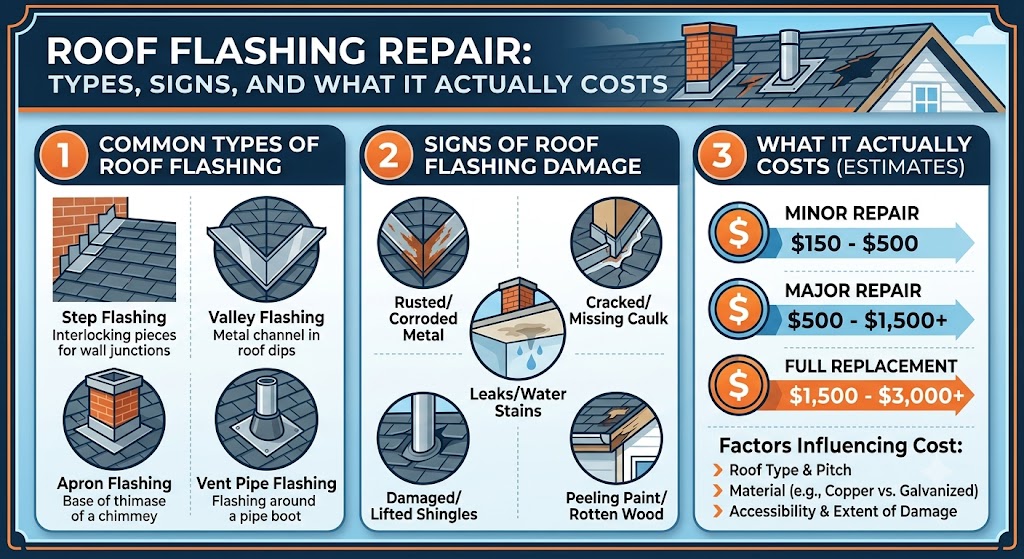
What Is Roof Flashing?
Roof flashing is a weatherproofing material — almost always metal, sometimes rubber or PVC on flat roofs — installed at any point where your roofing surface changes direction, meets a vertical structure, or has a penetration through it. Its only job is to direct water away from that joint instead of letting it seep underneath.
Flashing matters because shingles and roofing membrane alone can’t seal these transition points. A flat plane of shingles sheds water fine on its own; the moment there’s a chimney, a wall, a pipe, or a valley interrupting that plane, something else has to handle the seal — that’s flashing’s job.
Types of Roof Flashing
Different parts of a roof need different flashing types, each with its own failure pattern:
- Step flashing — L-shaped pieces woven between shingle courses where a roof meets a vertical wall or chimney, overlapping like shingles to shed water downward
- Valley flashing — runs along the internal angle where two roof slopes meet, channeling a large volume of water and taking heavy wear as a result
- Chimney/counter-flashing — a two-part system at the chimney: step flashing on the roof side, counter-flashing embedded into the masonry above it. See our chimney flashing repair guide for the signs and causes specific to this type, or our chimney counter-flashing repair service page for pricing and process.
- Vent pipe (boot) flashing — a rubber or metal collar sealing around plumbing and exhaust vent pipes, one of the most common failure points due to rubber degrading faster than metal
- Skylight flashing — a frame system around skylights, prone to seal failure as caulking and gaskets age
- Drip edge flashing — runs along roof edges (eaves and rakes) to direct water into gutters instead of behind fascia boards
- Wall/base flashing — where a roof meets a vertical wall without a chimney, common on additions and dormers
- Flat roof/parapet flashing — metal or membrane flashing along the edges and parapet walls of flat roofs, sealing the transition between the roofing membrane and the vertical wall
Signs You Need Flashing Repair
Flashing failure rarely announces itself directly — it shows up as water damage somewhere else first. Watch for:
- Water stains on ceilings or walls that appear near a roof penetration, wall junction, or roof valley rather than in the middle of an open ceiling
- Rust streaks running down siding, brick, or roofing material below a flashing joint
- Visibly lifted, bent, or separated metal at any roof transition point
- Damp or discolored insulation in the attic, especially near chimneys, vent pipes, or where the roof meets a wall
- Musty odors in upper-floor rooms, indicating trapped moisture behind a wall or ceiling
- Granule buildup or debris pooling near a valley, which often signals the valley flashing beneath is compromised
- Visible daylight through roof boards at penetration points, seen from inside the attic
If you’re seeing water intrusion specifically around a chimney, our chimney flashing repair guide breaks down exactly how to tell a chimney flashing leak apart from a general roof leak.
If you’re not sure whether your leak is coming from the chimney, the flashing, or somewhere else on the roof entirely, our guide to diagnosing a leak around your chimney walks through how to narrow it down before calling anyone.
What Causes Flashing to Fail?
- Age and material fatigue — most metal flashing lasts 15-20 years before thinning, rusting, or losing its watertight seal; rubber vent boots often fail sooner, closer to 10-15 years
- Poor original installation — flashing that wasn’t woven correctly into shingle courses, or wasn’t properly sealed at a wall or chimney junction, tends to fail early
- Storm and wind damage — high winds work fasteners loose and lift the edges of step and valley flashing
- Thermal expansion and contraction — metal flashing expands and contracts with temperature swings, gradually working seals and fasteners loose over years
- Freeze-thaw cycling — particularly hard on flashing embedded in masonry, like chimney counter-flashing, where moisture in mortar joints freezes and widens the gap holding the flashing in place
- UV and weather exposure — rubber and sealant-based flashing components degrade faster under constant sun and rain exposure than metal does
- Debris buildup — leaves and moss trap moisture against flashing seams, accelerating corrosion, particularly in valleys
Vancouver’s climate accelerates most of these failure modes — we cover the mechanics of that in more detail in how Vancouver’s rainy climate damages chimneys faster, which applies to flashing generally, not just chimneys.
Which Flashing Material Lasts Longest?
If you’re facing a replacement rather than a spot repair, material choice affects both upfront cost and how soon you’ll be dealing with this again:
| Material | Typical Lifespan | Cost | Notes |
|---|---|---|---|
| Aluminum | 20-25 years | $ | Lightweight, resists rust, can corrode near saltwater air |
| Galvanized steel | 15-20 years | $ | Budget-friendly, but the zinc coating wears thin over time in wet climates |
| Copper | 50+ years | $$$ | Premium option, develops a protective patina, often used on heritage homes |
| Stainless steel | 30-40 years | $$ | Strong corrosion resistance, common for chimney counter-flashing |
Galvanized steel is the most common material on older Metro Vancouver homes, and it’s also why flashing failure is so common here — most of it is nearing or past its practical lifespan simply due to age. If you’re replacing flashing anyway, upgrading to aluminum or stainless steel costs modestly more upfront but avoids repeating the same repair in another 15 years.
Flat Roof Flashing Repair: What’s Different
Flat and low-slope roofs — common on additions, garages, and some full home roofs finished in torch-on membrane or EPDM rubber — handle flashing differently than a sloped shingle roof. Since there’s no slope to help shed water quickly, flat roof flashing has to hold a watertight seal under standing water for longer periods, which makes it more failure-prone over time.
Common flat roof flashing issues include:
- Parapet wall flashing pulling away where the membrane meets a vertical wall
- Membrane seams near flashing edges cracking or lifting, especially at corners
- Pooling water sitting against poorly sloped flashing details, accelerating deterioration
- UV degradation of membrane-based flashing, particularly on EPDM rubber roofs
Flat roof flashing repair typically requires membrane-specific expertise — patching or resealing torch-on and EPDM systems is a different skill set than shingle-roof flashing work. If you’re dealing with a flat or low-slope roof, confirm your contractor has specific experience with your roofing material before booking.
DIY vs. Professional Flashing Repair
Basic visual inspection — checking for lifted metal, obvious gaps, or rust from the ground with binoculars — is reasonable for a homeowner to do. Actual repair is a different matter:
Flashing repair often requires removing roofing material. Properly repairing step or valley flashing means lifting surrounding shingles, which risks further damage if done without experience.
Height and roof-pitch risk are real. Most flashing failures occur at roof height, and steep or wet roofs are genuinely dangerous to work on without proper equipment.
Caulk-only fixes tend to fail fast. A common DIY mistake is sealing a visible gap with caulk instead of correcting the underlying flashing. This often traps moisture rather than solving the problem, accelerating rot behind the patch.
How Much Does Roof Flashing Repair Cost?
Costs vary by flashing type, scope, and whether masonry work is involved:
- Minor flashing resealing or spot repair: $150 – $500
- Step or valley flashing repair (localized): $300 – $1,200
- Full flashing replacement (single section): $500 – $1,800
- Chimney flashing repair specifically: costs vary based on whether masonry reglets need cutting — see our chimney repair cost guide for chimney-specific pricing
- Flat roof/parapet flashing repair: $400 – $2,000, depending on membrane type and access
Get a written estimate before committing — flashing pricing depends heavily on whether the surrounding roofing material or masonry also needs work, which isn’t always obvious until a contractor inspects in person.
Real Flashing Repair Examples Across Metro Vancouver
Cost ranges are useful, but seeing how they play out on actual jobs makes budgeting easier. Here’s what a few common flashing repairs typically look like across the region:
- Valley flashing resealing, Burnaby: Localized repair after granule buildup signaled early wear — around $350-$450
- Vent boot replacement, Surrey: Rubber collar had degraded and cracked — around $250-$350
- Chimney counter-flashing reglet repair, Richmond: New reglet cut and flashing reset into the mortar joint — around $600-$900
- Flat roof parapet flashing repair, Port Moody: Membrane resealed at a pulling parapet edge — around $500-$700
These are representative ranges based on typical scope, not fixed quotes — every roof is different, which is why we start with a free, no-obligation inspection. We provide flashing repair across Metro Vancouver, including Burnaby, Surrey, Richmond, New Westminster, Port Moody, and Port Coquitlam.
Finding Reliable Flashing Repair Near You
If you’re searching for “flashing repair near me,” a few things separate a contractor who’ll fix the actual problem from one who’ll patch the symptom:
- In-person inspection before quoting. Flashing problems are hard to diagnose accurately without seeing the roof directly — be cautious of anyone quoting sight unseen.
- Material-specific experience. Confirm they’ve worked with your roofing type — shingle, torch-on, EPDM, cedar shake — since flashing technique differs by material.
- WorkSafeBC registration and insurance, since this work happens at height.
- A written estimate that separates flashing work from any additional roofing or masonry repair.
- A warranty on the repair. Flashing work should come with a written guarantee, not just a verbal assurance.
Frequently Asked Questions
What’s the difference between flashing repair and a full roof repair?
Flashing repair addresses specific leak points at joints and transitions. A full roof repair covers broader issues like damaged shingles, granule loss, or structural decking problems. Many leaks that seem like roof failures are actually isolated flashing issues, which is why a proper inspection matters before assuming you need extensive work.
How much does chimney flashing repair cost?
Chimney flashing repair typically costs more than other flashing types because it usually involves cutting a new reglet into the mortar joint, not just replacing metal. See our chimney repair cost guide for a full breakdown.
How long does flashing repair take?
Minor spot repairs are often completed in a few hours. Full flashing replacement on a section of roof typically takes a full day, depending on accessibility and weather.
Can flashing be repaired without removing shingles?
In some cases, minor resealing can be done without removing shingles, but proper step and valley flashing repair usually requires lifting surrounding shingles to install new flashing correctly rather than working around them.
Is flashing repair covered by home insurance?
It depends on the cause. Sudden damage from a storm is more likely to be covered than gradual deterioration from age, which most insurers treat as a maintenance issue. Check your specific policy.
What’s the best time of year for flashing repair in Vancouver?
Late summer through early fall, before the wet season, gives sealants and any masonry work time to cure properly before winter rain arrives.
Whether it’s a chimney, a valley, a skylight, or a flat roof edge, flashing problems are almost always cheaper to fix early than to leave. If you’re seeing signs of a leak anywhere on your roof, get in touch for a free inspection, or explore our full roof repair services to see the complete range of work we handle across Metro Vancouver.
Related Reading
- Chimney Flashing Repair: Signs of a Roof Leak — chimney-specific flashing signs and repair process
- Leak Around Your Chimney? How to Find the Source First — a diagnostic walkthrough if you’re not sure what’s actually failing
- Chimney Crown Sealer: A DIY Guide — for water issues at the top of the chimney rather than the roofline