
Quick answer: To choose a chimney sweep, verify their credentials and WorkSafeBC standing, confirm they carry liability insurance, and ask for a written scope that includes an inspection and a report with photos. Compare quotes on what’s included, not just the price, and walk away from anyone who pushes repairs on the spot.
Chimney sweeping looks like a simple job, but there is a lot of variation underneath it. Two companies can quote similar prices and deliver very different visits. One clears the flue, inspects it, photographs what it finds, and hands you a written report. The other brushes the liner, announces expensive “problems,” and pushes repairs before leaving. Neither will tell you which kind of company it is unless you ask.
This guide gives you nine questions that bring the difference out, what a good answer sounds like, and the red flags that should end the call.
Why Choosing Carefully Matters
A sweep is on your roof and inside your firebox, and what they tell you about creosote, liner cracks, and structural damage drives real safety decisions and real spending. A thorough sweep catches problems while they’re cheap. A careless one can miss a cracked liner, or at the other extreme, invent problems to sell repairs.
You can’t judge that by the price quoted over the phone. Credentials, insurance, and a written scope are how you tell the two apart before anyone arrives at your door.
9 Questions to Ask Before You Book
1. What certification do your technicians hold, and can I verify it?
Common credentials in this trade include CSIA (Chimney Safety Institute of America) certification and, for work on wood-burning systems in Canada, WETT (Wood Energy Technology Transfer). A good answer names the credential, says which technicians hold it, and tells you how to check it.
A certificate isn’t the only sign of competence. In-house training and years on the job count too. But a company that can’t say what training its technicians have is telling you something.
2. Are you registered with WorkSafeBC, and do you carry liability insurance?
Chimney work happens at height. Ask for a WorkSafeBC clearance letter and a certificate of liability insurance. This protects you: if a worker is hurt on your roof or something is damaged inside your home, you want the contractor’s coverage to respond, not your homeowner’s policy.
3. What level of inspection is included?
A sweep should include at least a Level 1 visual inspection, since the technician is looking at the same components anyway. Ask whether a video scan is available if they see something they can’t judge by eye. Our chimney inspection process guide explains what each level covers, and the inspection cost guide shows what each costs.
4. What exactly is in the quoted price?
Ask what the quote covers: how many flues, wood or gas, whether heavy creosote or hard roof access changes the price, and whether a written report is included. A quote that can’t say what it covers can’t be compared with another one. Our chimney sweep cost guide explains what moves the price.
5. How do you contain the mess?
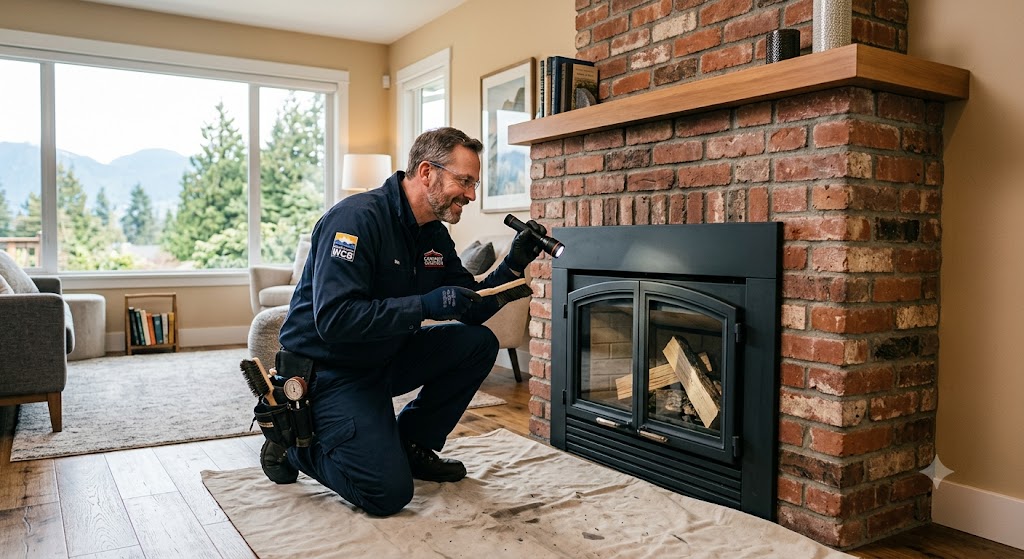
Drop cloths over the floor and a HEPA vacuum on the firebox are the baseline. Ask where they’ll set up and how they’ll protect your floors and furniture. A well-run sweep leaves the room cleaner than it found it.
6. Will I get a written report with photos?
You should leave with a record of what was found, photos, recommendations, and when to sweep next. You’ll want it for insurance, and again if you ever sell the home. A technician who won’t photograph findings is asking for trust you haven’t had a reason to give.
7. What happens if you find a problem?
A good answer sounds like this: they explain what they found, show you the photo, give a written estimate, and leave the decision to you. Sweeping and repair should be separate conversations. If the problem turns out to be masonry or flashing rather than buildup, our guide on who to call for chimney repair explains which trade fixes what.
8. Can I see local references or recent work?
Reviews help, but read them for patterns rather than star counts, including how the company responds to the negative ones. Ask for references from homes similar to yours, or before-and-after photos of recent jobs.
9. Who will actually come to my home?
Find out whether it’s the company’s own crew or a subcontractor, get the technician’s name and an arrival window, and ask whether they call ahead if they’re running late. It’s a small question that tells you a lot about how the business is run.
Good Answer vs. Warning Sign: Quick Reference
| Question | A good answer | A warning sign |
| Certification | Names the credential and how to verify it | “We’ve been doing this for years,” with nothing else |
| WorkSafeBC and insurance | Provides a clearance letter and insurance certificate | Hesitates or says “we’re covered” without proof |
| Inspection | Level 1 included, video scan offered if needed | Sweep only, “inspection” costs extra |
| Price | Itemized scope, flues and fuel type stated | One number with no detail |
| Mess | Drop cloths and HEPA vacuum | “It’s not that messy” |
| Report | Written, with photos | Verbal summary only |
| Problems found | Explained, photographed, quoted in writing | Pressure to approve repairs today |
| References | Local references or recent photos | “Check our reviews,” and nothing else |
| Who comes | Named technician, arrival window | Vague, or sends whoever is free |
Red Flags That Should End the Call
- A door-knocker or cold call offering a surprise discount on chimney work
- An advertised price far below the normal range with no explanation of what’s included
- No inspection as part of the sweep
- Pressure to approve repairs the same day, or repair quotes with no photos
- A large deposit for a routine sweep, or a request to pay an individual rather than the registered company
- No company name, registration, or insurance details when you ask
- Refusing to put the scope in writing
What a Fair Visit Looks Like
Before the visit you should have a confirmed scope and an arrival window. During it, the technician protects the floor, sweeps the flue from the top down, and inspects the firebox, damper, and visible liner. Afterward you should receive the findings in writing, with photos, and a clear recommendation on whether anything needs attention and when to book your next sweep. Most visits run 45 to 90 minutes.
If you want to know what to expect in more detail, see signs you need a chimney sweep now and how often you should schedule a chimney sweep.
Before You Call: What to Have Ready
A few details help any company quote accurately, and a good one will ask for them without prompting:
- Fuel type. Wood, gas, pellet, or oil, since each cleans differently.
- Number of flues. Older homes often have a fireplace flue plus a separate furnace or water-heater vent.
- When it was last swept. If you don’t know, say so. It affects how much buildup to expect.
- How much you burn. Roughly how many cords or how many fires per week in season.
- Any symptoms. Smoke drifting into the room, a smoky smell, a hard-to-light fire, or noises in the flue.
If a company quotes a flat price without asking any of this, treat the quote as an estimate that may change on arrival.
Sweep Company or Repair Contractor?
Many sweeps also handle caps, dampers, and liners. Structural brickwork and crown repair usually need a mason. If your chimney needs more than cleaning, check that the company you’re hiring actually does that work rather than referring it out. Our masonry contractor hiring guide has the longer checklist for repair work.
What Should a Chimney Sweep Cost?
A standard sweep in Metro Vancouver typically runs $200 to $350, rising to $350 to $600 for heavy creosote or difficult access, and gas fireplace cleaning usually costs less. An advertised price well under that range isn’t automatically a scam, but it’s a reason to ask what’s included. The full cost breakdown covers what affects it.
Choosing a Chimney Sweep Across Metro Vancouver
Red Brick Chimney Services provides chimney sweeping and cleaning across Metro Vancouver, including Vancouver, Burnaby, Surrey, Richmond, New Westminster, Port Moody, and Port Coquitlam. Every sweep includes a Level 1 inspection and a written report of findings.
Frequently Asked Questions
What certification should a chimney sweep have?
Look for a recognized credential such as CSIA, and WETT for wood-burning systems, and ask how to verify it. Also confirm WorkSafeBC registration and liability insurance, which matter as much as any certificate.
How do I know if a chimney sweep is legitimate?
Check that they give a company name and registration, carry insurance, provide a written scope, and are willing to share local references. Be cautious of unsolicited offers and prices that are far below the normal range.
How long does a chimney sweep take?
Most residential sweeps take 45 to 90 minutes, depending on chimney height, access, and how much buildup has accumulated.
Do I need to be home during a chimney sweep?
Someone usually needs to be there to give access to the fireplace and review the findings. Confirm this when you book.
Can a chimney sweep also repair my chimney?
Some can handle caps, dampers, and liners. Masonry and flashing repair are usually done by a mason or a roofing and masonry contractor. Ask what they actually do in-house before booking.
When is the best time to book a chimney sweep?
Summer and early fall are ideal, since scheduling is easier and any problems found can be fixed before burning season. Sweeps are available year-round.
Ready to book with a company that checks all nine boxes? Get in touch for a free inspection, or see our chimney sweeping and cleaning service for what every visit includes.